
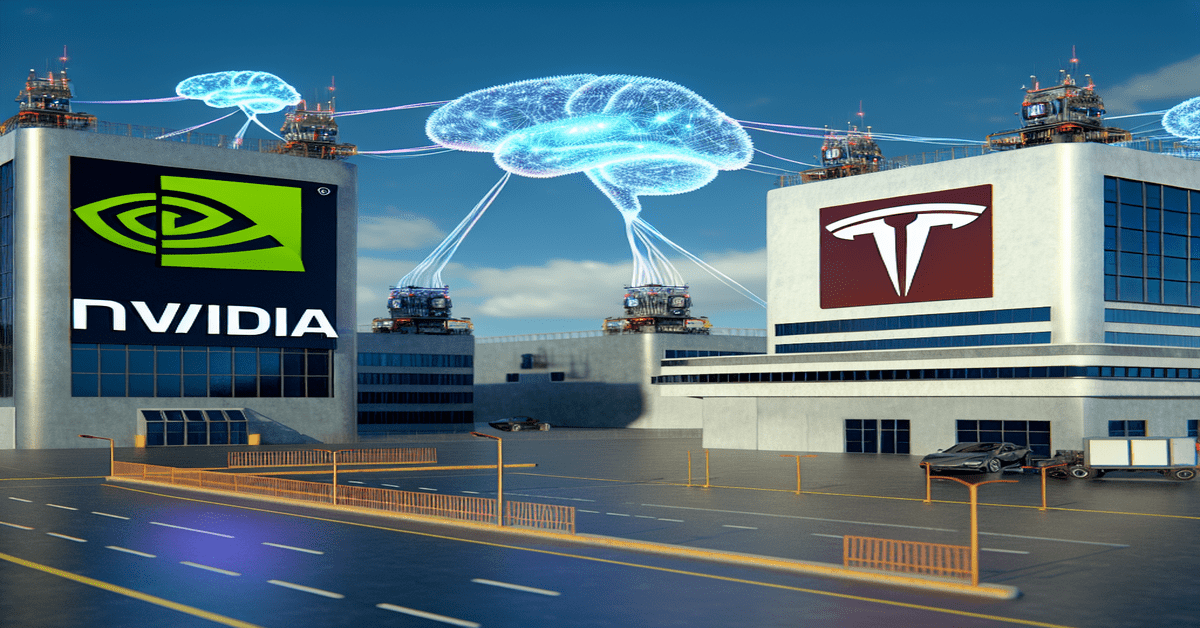
Tesla’s AI Ambitions: A Looming Threat to Nvidia’s Dominance
As the world of technology continues to evolve at a breakneck pace, the race for dominance in the realm of artificial intelligence (AI) is heating up. While many industry experts have their eyes on the likes of AMD as the primary competitor to Nvidia’s throne, a new contender has emerged from an unlikely corner: Tesla (TSLA). With its rapidly advancing Autopilot system and growing expertise in AI, Tesla is poised to become a formidable rival to Nvidia in the near future.
The Rise of Tesla’s Autopilot
Tesla’s Autopilot system has been making waves in the automotive industry, showcasing the company’s prowess in harnessing the power of AI. What began as a driver assistance feature has evolved into a sophisticated system capable of navigating complex road situations with increasing autonomy. The Autopilot’s ability to learn and adapt to various driving scenarios has caught the attention of both consumers and industry experts alike.
As Tesla continues to refine and enhance its Autopilot technology, the potential for its application extends far beyond the realm of automobiles. The underlying AI architecture that powers the Autopilot system could be leveraged across a wide range of industries, from robotics and manufacturing to healthcare and beyond. This versatility positions Tesla as a serious contender in the AI market, challenging the dominance of established players like Nvidia.
Nvidia’s AI Dominance Under Threat
Nvidia has long been regarded as the go-to provider of AI and graphics processing units (GPUs), powering some of the most advanced AI systems in the world. The company’s cutting-edge technology has been instrumental in driving breakthroughs in fields such as deep learning, computer vision, and natural language processing. However, Tesla’s rapid advancements in AI could pose a significant threat to Nvidia’s market share.
Tesla’s in-house AI development efforts have yielded impressive results, with the company’s neural networks demonstrating remarkable capabilities in tasks such as object recognition, decision-making, and predictive modeling. As Tesla continues to refine its AI algorithms and hardware, it could potentially erode Nvidia’s competitive advantage in the AI chip market.
Moreover, Tesla’s vertically integrated approach to AI development sets it apart from traditional technology companies. By controlling every aspect of its AI stack, from data collection and annotation to hardware design and software optimization, Tesla can achieve unparalleled synergy and efficiency. This holistic approach could give Tesla a significant edge over competitors like Nvidia, who rely on partnerships and third-party components.
The Future of AI Competition
As the AI landscape continues to evolve, the competition between Tesla and Nvidia is likely to intensify. Both companies possess immense talent, resources, and ambition, making them formidable contenders in the race for AI supremacy. However, Tesla’s unique position as a vertically integrated AI powerhouse could give it a distinct advantage.
The implications of this rivalry extend far beyond the realm of technology. As AI becomes increasingly embedded in our daily lives, from autonomous vehicles to smart homes and beyond, the companies that dominate this space will wield tremendous influence over the future of society. The battle between Tesla and Nvidia is not just about market share; it’s about shaping the very fabric of our AI-driven world.
Conclusion
In the rapidly evolving world of AI, Tesla’s emergence as a serious competitor to Nvidia is a development that cannot be ignored. With its advanced Autopilot system and growing expertise in AI, Tesla is well-positioned to challenge Nvidia’s dominance in the AI chip market. As the competition between these two titans intensifies, the future of AI hangs in the balance.
As industry experts and enthusiasts, it is crucial that we keep a close eye on this unfolding rivalry. The outcome of this battle will have far-reaching implications for the technology sector and society as a whole. By engaging in meaningful discussions, sharing insights, and staying informed about the latest developments, we can collectively navigate the exciting and uncharted territory that lies ahead.
So, what are your thoughts on Tesla’s potential to rival Nvidia in the AI space? How do you see this competition shaping the future of AI and its applications? Share your opinions, predictions, and insights in the comments below, and let’s engage in a thought-provoking dialogue about the future of AI and the companies that will shape it.
#TeslaAI #NvidiaCompetition #ArtificialIntelligence #Tesla
- Original article and inspiration provided by Opahl TechnologiesAdam Spatacco
- Connect with one of our AI Strategists today at Opahl Technologies
