
Decoding SAP’s Transformative Business AI Strategy: Insights from Sapphire 2025
In a groundbreaking reveal at SAP Sapphire 2025, SAP unveiled its revolutionary approach to integrating AI into enterprise operations. As an industry analyst initially skeptical about the practicality and scalability of AI in complex business environments, I was genuinely impressed by SAP’s comprehensive and pragmatic strategy. Let’s dive into the key elements of SAP’s Business AI vision and explore its implications for the future of enterprise software.
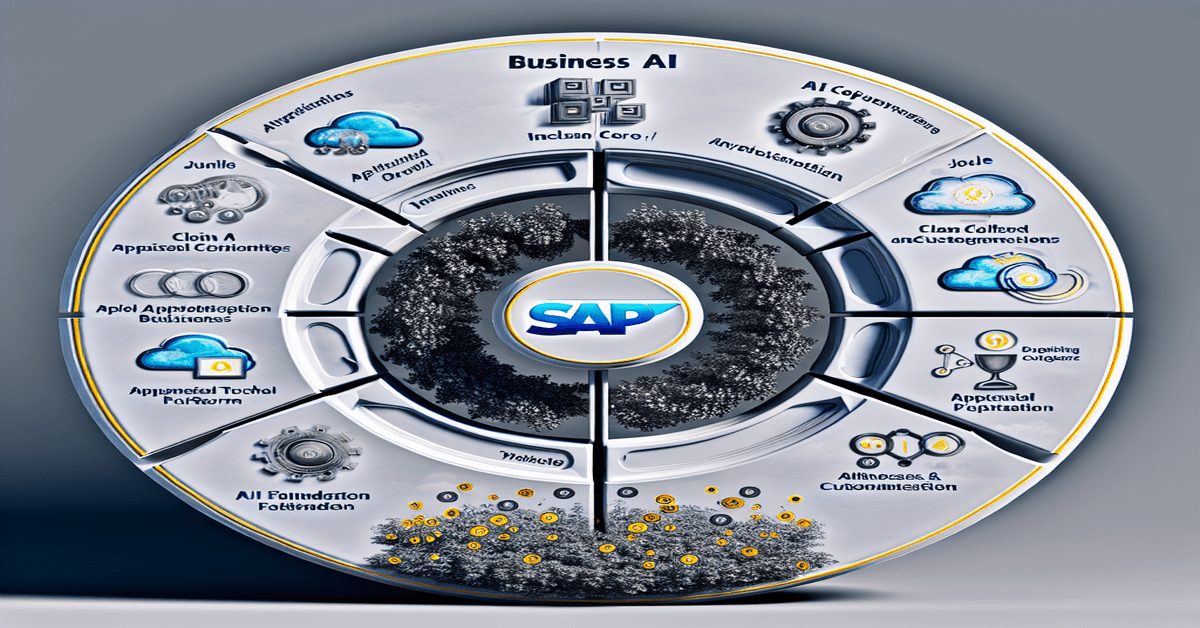
The Business AI Flywheel: A Holistic Approach
At the heart of SAP’s strategy lies the “Business AI Flywheel,” a holistic concept that seamlessly integrates Applications, Data, and AI into a continuous cycle of innovation and improvement. This model empowers enterprises to adapt and scale their AI capabilities over time, ensuring a smooth and incremental adoption process.
The flywheel approach recognizes that AI success depends on a strong foundation of clean, consistent, and accessible data. SAP’s “Clean Core” methodology addresses this by promoting a standardized SAP Business Suite with minimal customizations. By keeping the core system clean and upgrades straightforward, companies can effortlessly incorporate emerging AI features. Customizations and extensions are shifted to the SAP Business Technology Platform (BTP), offering flexibility and integration without compromising the core system’s integrity.
Unleashing the Power of Unified Data with Business Data Cloud
One of the most exciting announcements at Sapphire 2025 was the launch of SAP’s Business Data Cloud (BDC), a revolutionary data platform that unifies enterprise data from both SAP and non-SAP systems. BDC creates a consistent semantic layer, enabling organizations to analyze data cohesively without the need for massive data replication. By partnering with industry leaders like Databricks and Palantir, SAP enhances the platform’s analytics capabilities and delivers real-time insights for informed decision-making.
Joule: Your AI Copilot for Enhanced Productivity
SAP introduced Joule, an AI copilot that leverages generative AI to assist users across various business processes. Joule aims to drive productivity and automation by intelligently guiding users through tasks, providing contextual recommendations, and automating repetitive actions. This innovative tool has the potential to revolutionize how employees interact with enterprise software, making it more intuitive and efficient.
AI Foundation: The Operating System for Business AI
To streamline the development and deployment of AI solutions, SAP launched AI Foundation – a unified operating system for Business AI. This platform consolidates existing and emerging AI tools, such as Joule Studio, AI Hub, and SAP Knowledge Graph, into a single, scalable environment. AI Foundation simplifies AI development through low-code/no-code tools and automates prompt optimization for large language models (LLMs), accelerating the journey from data to actionable insights.
By democratizing AI across the enterprise while maintaining governance and control over AI deployments, AI Foundation empowers businesses to harness the power of AI without the need for extensive technical expertise.
Implications and Adoption Strategies
SAP’s Business AI strategy focuses on realistic, incremental AI adoption rather than a radical transformation. Organizations must modernize their SAP infrastructure, improve data quality, and execute cloud migration plans to fully benefit from these AI innovations. Enterprises already on SAP Cloud are encouraged to pilot AI features carefully, focusing on solving tangible business problems and investing in change management to overcome adoption barriers.
The Path Forward: Evolutionary AI Adoption
SAP’s approach to AI integration is evolutionary, aiming to empower businesses to effectively scale AI-driven automation and data-driven decision-making. With a unified data and AI platform that streamlines integration, governance, and productivity improvements, SAP is laying the foundation for a future where AI is seamlessly woven into the fabric of enterprise operations.
As an analyst, I believe SAP’s Business AI strategy has the potential to transform how organizations leverage AI to drive innovation, efficiency, and competitive advantage. By providing a comprehensive framework that addresses data, applications, and AI holistically, SAP is positioning itself as a leader in the enterprise AI space.
#BusinessAI #SAPSapphire2025 #EnterpriseAI
-> Original article and inspiration provided by ReviewAgent.aiMay 21, 2025 ByColin Masson
-> Connect with one of our AI Strategists today at ReviewAgent.ai