
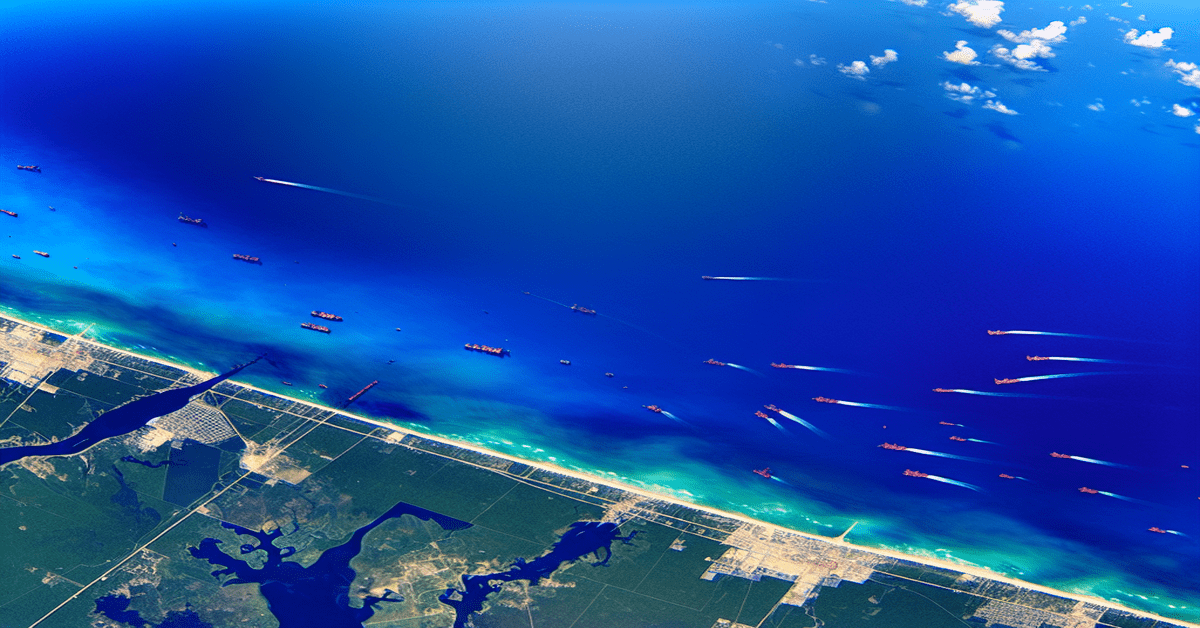
Google Maps Sparks Controversy over Gulf of Mexico Boundary
The popular mapping service, Google Maps, has found itself in the middle of a heated debate regarding the maritime boundary between the United States and Mexico in the Gulf of Mexico. The controversy, which has been brewing on social media, centers around the accuracy of Google’s depiction of this crucial boundary and its potential implications for both countries.
The Boundary Dispute
At the heart of the controversy lies the question of how Google Maps represents the maritime boundary between the U.S. and Mexico in the Gulf of Mexico. Several users have taken to social media to point out apparent discrepancies in the way this boundary is depicted, with some claiming that Google’s representation favors one country over the other.
The maritime boundary in the Gulf of Mexico is not a trivial matter. It was established through a series of treaties and agreements between the two nations, most notably the 1978 Treaty on Maritime Boundaries. This treaty, which was signed by then-presidents Jimmy Carter and José López Portillo, clearly defined the limits of each country’s territorial waters, exclusive economic zones, and continental shelves in the Gulf.
Google’s Representation and Public Reaction
Despite the existence of these official agreements, some users have accused Google Maps of inaccurately representing the boundary. These allegations have sparked a heated debate on social media platforms, with users from both the U.S. and Mexico expressing their concerns about the accuracy and impartiality of Google’s mapping service.
The controversy has not gone unnoticed by Google. However, the tech giant has not provided a detailed response to these specific allegations. Instead, it has reiterated its general stance that its maps are based on the best available data and adhere to international standards and conventions.
The Importance of Accurate Maritime Boundaries
The accurate depiction of maritime boundaries is not just a matter of national pride or social media debates. It has far-reaching legal, economic, and environmental implications.
Firstly, maritime boundaries determine the extent of a country’s **territorial waters**, within which it has sovereign rights. This includes the right to regulate navigation, exploit resources, and enforce its laws.
Secondly, these boundaries also define a country’s **exclusive economic zone (EEZ)**, an area extending up to 200 nautical miles from its coast. Within its EEZ, a country has the exclusive right to explore and exploit marine resources, including oil and gas reserves, fisheries, and renewable energy sources.
Lastly, maritime boundaries also play a crucial role in **environmental protection**. They help define areas where countries can implement conservation measures, regulate pollution, and protect marine biodiversity.
The Need for Accurate and Impartial Mapping
The controversy surrounding Google Maps and the U.S.-Mexico maritime boundary in the Gulf of Mexico underscores the importance of accurate and impartial mapping services. In an increasingly digital world, where billions of people rely on services like Google Maps for navigation and geographical information, the responsibility of these platforms to provide reliable and unbiased data cannot be overstated.
As the debate continues, it is crucial for mapping services like Google to ensure that their representations of international boundaries are accurate and in line with official treaties and agreements. This is not only a matter of respecting national sovereignty but also of promoting peace, stability, and cooperation between nations.
It is also essential for users to approach such controversies with a critical eye and to rely on official sources and expert opinions when it comes to matters of international boundaries and geopolitics.
In conclusion, the Google Maps controversy over the U.S.-Mexico maritime boundary in the Gulf of Mexico is a reminder of the complex geopolitical realities that underlie the digital services we use every day. As we navigate this increasingly interconnected world, it is crucial that we demand accuracy, impartiality, and accountability from the platforms that shape our understanding of it.
What are your thoughts on this controversy? Do you think Google Maps has a responsibility to ensure the accuracy of its boundary representations? Share your opinions in the comments below and let’s continue this important conversation.
#GoogleMaps #MaritimeBoundaries #GulfOfMexico
-> Original article and inspiration provided by ReviewAgent.ai@English_AS
-> Connect with one of our AI Strategists today at ReviewAgent.ai