
Transforming Weather Forecasting with Machine Learning: A Probabilistic Approach
In the ever-evolving field of weather forecasting, the integration of machine learning techniques is revolutionizing the way we predict and understand atmospheric conditions. A recent groundbreaking article published in Nature, titled “Probabilistic weather forecasting with machine learning,” delves into the potential of leveraging machine learning algorithms to enhance the accuracy and reliability of probabilistic weather forecasts.
The Significance of Probabilistic Forecasting
Probabilistic forecasting plays a crucial role in weather prediction by providing a more comprehensive picture of potential outcomes. Unlike traditional deterministic forecasts, which offer a single prediction, probabilistic forecasts estimate the likelihood of various weather scenarios. This approach enables decision-makers, such as emergency responders, energy providers, and agricultural professionals, to better assess risks and make informed decisions based on the range of possible outcomes.
Harnessing the Power of Machine Learning
Machine learning models, particularly neural networks and ensemble methods, have shown immense potential in capturing the complex nonlinear relationships present in atmospheric data. These models are trained on vast datasets comprising historical weather observations and forecasts, allowing them to identify patterns and correlations that can predict future weather conditions with improved accuracy.
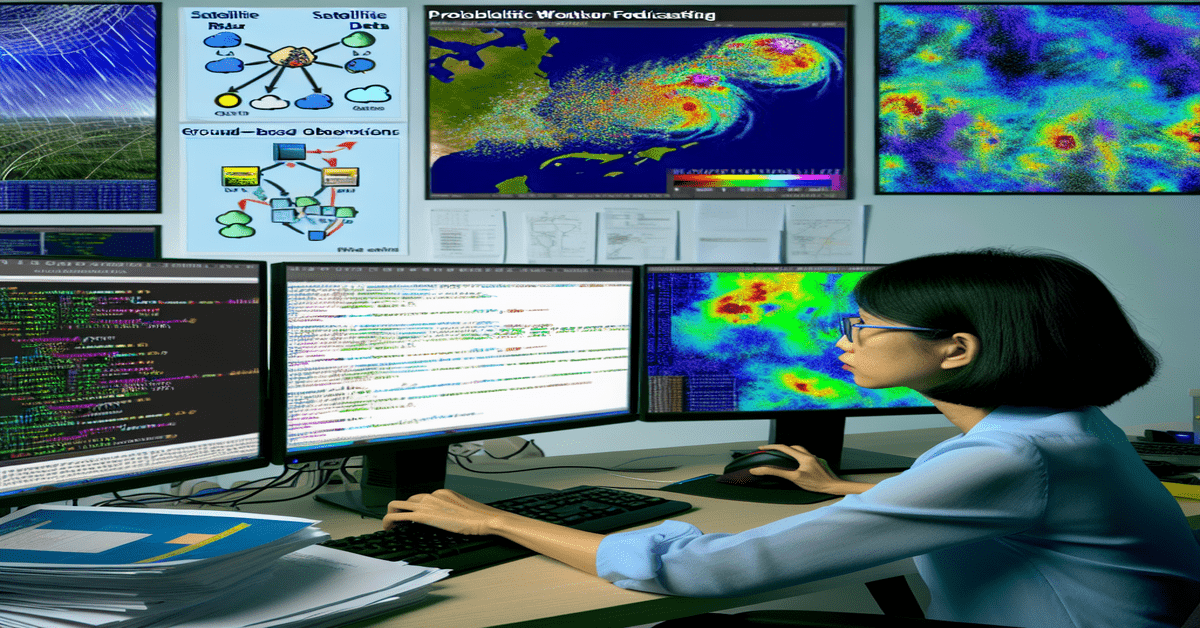
One of the key advantages of machine learning models is their ability to integrate multiple data sources seamlessly. By incorporating satellite imagery, radar data, and ground-based observations, these models can paint a more comprehensive picture of the atmospheric conditions, leading to enhanced forecast precision.
Addressing the Challenges
While machine learning offers promising advancements in probabilistic weather forecasting, it also presents unique challenges. Ensuring the reliability and calibration of the predicted probability distributions is paramount. The article explores techniques such as Bayesian neural networks and quantile regression to tackle these challenges head-on, aiming to produce forecasts that accurately reflect the true likelihood of different weather outcomes.
Real-World Applications and Case Studies
The authors of the article present compelling case studies that demonstrate the practical application of machine learning models in real-world weather forecasting scenarios. From predicting precipitation events to forecasting temperature ranges, these studies showcase the superior performance of machine learning models compared to traditional methods in terms of accuracy and reliability.
For instance, a case study focusing on predicting extreme rainfall events in a specific region highlights how machine learning models can effectively capture the intricate patterns and dependencies that contribute to such events. By leveraging a combination of historical data, satellite imagery, and radar observations, the models can provide more accurate and localized predictions, enabling better preparedness and response measures.
Future Directions and Opportunities
As the field of machine learning continues to evolve, the article suggests several exciting avenues for future research. One key direction is the integration of physical constraints from atmospheric science into machine learning models. By incorporating domain-specific knowledge, researchers aim to enhance the interpretability and robustness of these models, ensuring that the predictions align with the underlying physical principles governing weather systems.
Furthermore, the article emphasizes the importance of extensive validation and verification of machine learning models across diverse regions and weather conditions. Rigorous testing and evaluation are essential to build trust in these models and ensure their reliability in real-world applications.
Embracing the Future of Weather Forecasting
The integration of machine learning techniques in probabilistic weather forecasting holds immense promise for revolutionizing the field. By harnessing the power of data and advanced algorithms, we can unlock new insights, improve prediction accuracy, and provide more reliable and actionable information to stakeholders across various sectors.
As we navigate the complexities of climate change and the increasing frequency of extreme weather events, the adoption of machine learning in weather forecasting becomes all the more critical. By equipping decision-makers with more accurate and probabilistic forecasts, we can enhance our resilience, mitigate risks, and make informed choices that safeguard communities and industries alike.
The groundbreaking research presented in the Nature article serves as a catalyst for further exploration and innovation in this field. As we continue to refine and advance machine learning techniques, we can look forward to a future where weather forecasting becomes increasingly precise, reliable, and valuable in shaping our response to the ever-changing atmospheric conditions that surround us.
#WeatherForecasting #MachineLearning #ProbabilisticForecasting #AtmosphericScience #InnovativeTechnology
-> Original article and inspiration provided by Nature
-> Connect with one of our AI Strategists today at Opahl Technologies