
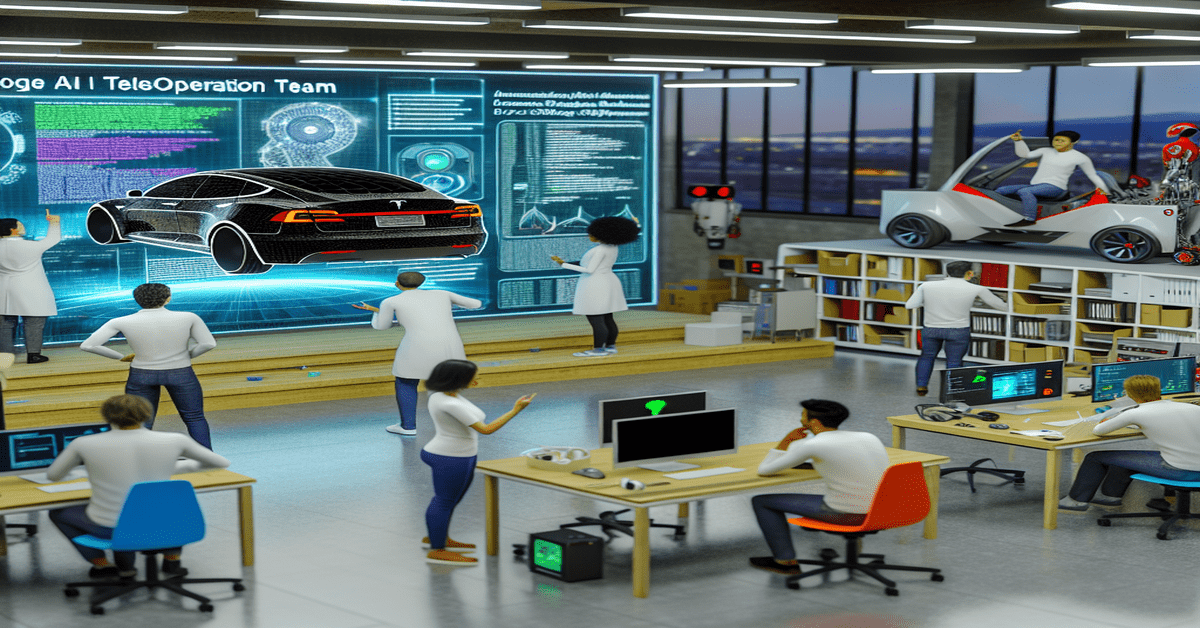
Tesla’s AI Teleoperation Team: Shaping the Future of Autonomous Driving
Tesla, the pioneering electric vehicle manufacturer, is making significant strides in the realm of autonomous driving. In a recent development, the company is assembling an ‘AI Teleoperation team’ to push the boundaries of remote vehicle control and operation. This move signifies Tesla’s unwavering commitment to revolutionizing the automotive industry and ushering in a new era of self-driving technology.
The Vision Behind AI Teleoperation
Tesla’s AI teleoperation initiative aims to enhance the capabilities of its autonomous driving systems by integrating cutting-edge artificial intelligence technologies. The goal is to enable human operators to remotely intervene and control vehicles when necessary, providing a crucial safety net in complex or unexpected situations.
By leveraging AI algorithms and advanced sensory systems, Tesla seeks to create a seamless interface between human operators and autonomous vehicles. This symbiotic relationship could potentially address some of the challenges faced by fully autonomous systems, such as navigating intricate urban environments or responding to unpredictable road conditions.
Investing in the Future
Tesla’s commitment to AI teleoperation is evident from its recent job listings for various roles related to this groundbreaking project. The company is actively seeking talented individuals with expertise in artificial intelligence, robotics, and remote operation technologies.
The formation of a dedicated AI teleoperation team signifies Tesla’s substantial investment in this area. By bringing together the brightest minds in the field, Tesla aims to accelerate the development of advanced teleoperation systems that can seamlessly integrate with its existing autonomous driving technologies.
Implications for the Autonomous Driving Landscape
The implications of Tesla’s AI teleoperation initiative extend far beyond the company itself. As one of the leading players in the autonomous vehicle industry, Tesla’s advancements have the potential to shape the future of self-driving technology as a whole.
By developing robust teleoperation systems, Tesla could pave the way for safer and more efficient deployment of autonomous vehicles on a larger scale. The ability to remotely intervene and control vehicles in real-time could alleviate concerns about the reliability and safety of self-driving cars, instilling greater public trust in the technology.
Moreover, the successful implementation of AI teleoperation could accelerate the adoption of autonomous vehicles across various sectors, including personal transportation, ride-sharing services, and even commercial trucking. The potential benefits are vast, ranging from reduced traffic congestion and lower carbon emissions to increased mobility for individuals who are unable to drive.
The Road Ahead
As Tesla forges ahead with its AI teleoperation team, the automotive industry eagerly awaits the fruits of their labor. While the exact timeline for the deployment of these advanced systems remains uncertain, one thing is clear: Tesla is at the forefront of shaping the future of autonomous driving.
The integration of AI teleoperation into Tesla’s existing autonomous driving technologies could be a game-changer, offering a new level of safety, efficiency, and flexibility. As the company continues to push the boundaries of what is possible, it is poised to revolutionize the way we think about transportation and mobility.
However, the path to widespread adoption of AI teleoperation is not without its challenges. Regulatory hurdles, public acceptance, and the need for robust cybersecurity measures are just a few of the obstacles that must be overcome. Nevertheless, with Tesla’s track record of innovation and its unwavering commitment to advancing autonomous driving technologies, there is reason to be optimistic about the future.
Conclusion
Tesla’s AI teleoperation initiative represents a significant step forward in the evolution of autonomous driving. By assembling a dedicated team focused on developing advanced remote control and operation technologies, Tesla is positioning itself at the vanguard of the industry.
The potential implications of this project are far-reaching, with the promise of safer, more efficient, and widely accessible autonomous transportation on the horizon. As Tesla continues to push the boundaries of what is possible, it is shaping the future of mobility and paving the way for a new era of self-driving technology.
#AutonomousDriving #AITeleoperation #TeslaInnovation
-> Original article and inspiration provided by Umar Shakir
-> Connect with one of our AI Strategists today at Opahl Technologies
